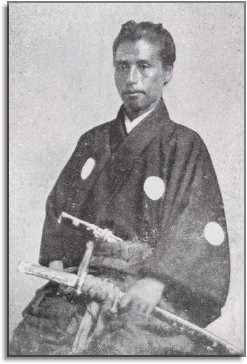
Photo from Takaaki Ishiguro
Ryoma : Life of a
Renaissance Samurai
by Romulus Hillsborough
First Literary Biography of Japan's Most Magnificent Samurai

|
Samurai Sketches
by Romulus Hillsborough
A collection of historical sketches from the bloody final years of
the Shogun, never before depicted in English

|
Katsu Kaishu, consummate samurai, streetwise denizen of
Downtown Edo, founder of the Japanese navy, statesman par excellence and always the
outsider, historian and prolific writer, faithful retainer of the Tokugawa Shogun and
mentor of men who would overthrow him was among the most remarkable of the numerous
heroes of the Meiji Restoration.
Kaishu's protégé was Sakamoto Ryoma, a key player in the overthrow of the Tokugawa
Shogunate. Surely Ryoma would agree that he owes his historical greatness to Kaishu, whom
Ryoma considered the greatest man in Japan.
Ryoma was an outlaw and
leader of a band of young rebels. Kaishu was the commissioner of the shogun¹s navy, who
took the young rebels under his wing at his private naval academy in Kobe, teaching them
the naval sciences and maritime skills required to build a modern navy.
Kaishu also imparted to
Ryoma his extensive knowledge of the Western world, including American democracy, the Bill
of Rights, and the workings of the joint stock corporation.
Kaishu was one of the
most enlightened men of his time, not only in Japan but in the world. The American
educator E. Warren Clark, a great admirer of Kaishu who knew him personally, called Kaishu
the Bismark of Japan, for his role in unifying the Japanese nation in the dangerous
aftermath of the fall of the Tokugawa.
Like Ryoma, Kaishu was an
adept swordsman who never drew his blade on an adversary, despite numerous attempts on his
life. Indeed the two men lived in dangerous times. I have been shot at by an enemy about
twenty times in all, Kaishu once said. I have one scar on my leg, one on my head, and two
on my side.
Kaishus defiance of death
sprung from his reverence for life. I despise killing, and have never killed a man. I used
to keep my sword tied so tightly to the scabbard, that I couldn't draw the blade even if I
wanted to.
Katsu Kaishu, who would
become the most powerful man in the Tokugawa Shogunate, was born in Edo in January 1823,
the only son of an impoverished petty samurai.
The Tokugawa had ruled
Japan peacefully for over two centuries. To ensure their supremacy over some 260 feudal
domains, the Tokugawa had strictly enforced a policy of national isolation since 1635. But
the end of the halcyon era was fast approaching, as the social, political and economic
structures of the outside world were undergoing major changes.
The nineteenth century
heralded the age of European and North American capitalism, and with it rapid developments
in science, industry and technology. The development of the steamship in the early part of
the century served the expansionist purposes of the Western powers. Colonization of Asian
countries by European powers surged. In 1818 Great Britain subjugated much of India.
Through the Treaty of Nanking, which ended the first Opium War in 1842, the British
acquired Hong Kong.
The Western encroachment
reached Japan in 1853, when Commodore Matthew Perry of the United States Navy led a
squadron of heavily armed warships into the bay off the shogun¹s capital, forcing an end
to Japanese isolation and inciting fifteen years of bloody turmoil across the island
nation.
Until Perry's arrival,
pursuers of foreign knowledge existed outside the mainstream of Japanese society. Kaishu
was an outsider, both by nature and circumstance. But when his sword master urged him to
discontinue fencing to devote himself to the study of Dutch, with the objective to learn
Western military science, the young outsider balked.
That it was frowned upon
for a direct retainer of the shogun to study Dutch had little, if any, impact on Kaishu.
He was innately inquisitive of things strange to him. He was also filled with a burgeoning
self-confidence. But the idea of learning a foreign language seemed to him preposterous.
He had never been exposed to foreign culture, except Chinese literature. It wasn't until
age eighteen that he first saw a map of the world.
I was wonderstruck, he
recalled decades later, adding that he had now determined to travel the globe.
Kaishu's wonderment was
perfectly natural. His entire world still consisted of a small, isolated island nation.
But his determination to travel abroad was strengthened by his discovery of strange script
engraved on the barrel of a cannon in the compounds of Edo Castle.
The cannon had been
presented to Edo by the Netherlands, and Kaishu correctly surmised that the engraving was
in Dutch. Thus far he had only heard about those foreigners, the Dutch, who lived
in a small, confined community in the distant Nagasaki.
Those foreigners had
occasionally fluttered through his mind as mere phantasm, the stuff of youthful
imagination. But now, for the first time, he saw in his mind's eye, however vaguely, the
people who had manufactured the cannon, and who had engraved in their own language the
inscription upon its barrel.
Those undecipherable
letters of the alphabet, written horizontally rather than vertically, served as cold
evidence of the actual existence of people who communicated in a language completely
different from his own, but who until now had only existed as so much hearsay.
Since these foreigners
were human beings like himself, why shouldn¹t he be able to learn their language? And
once he had learned their language, he would be able to read their books, learn how to
manufacture and operate their cannon and realize his aspiration to travel the world.
In the face of Perry's
demands, the shogunate conducted a national survey, calling for solutions to the foreign
threat. The shogunate received hundreds of responses, the majority of which, broadly
speaking, represented either of two conflicting viewpoints.
On one side were those
who proposed opening the country to foreigners. Their opponents advocated preserving the
centuries-old policy of exclusionism. But neither side offered a constructive means for
realizing their proposals.
In contrast, the memorial
submitted by one unknown samurai was clear, brilliant, progressive, and included concrete
advice for the future of Japan. In his memorial Kaishu pointed out that Perry had been
able to enter Edo Bay unimpeded only because Japan did not have a navy to defend itself.
He urged the shogunate to recruit men for a navy. He dared to propose that the military
government break age-old tradition and go beyond birthright to recruit men of ability,
rather than the sons of the social elite, and certainly there was nobody in all of Edo
more poignantly aware of this necessity than this impoverished, brilliant young man from
the lower echelons of samurai society.
Kaishu advised that the
shogunate lift its ban on the construction of warships needed for national defense; that
it manufacture Western-style cannon and rifles; that it reform the military according to
modern Western standards, and establish military academies.
Pointing out the great
technological advances being achieved in Europe and the Untied States, Kaishu challenged
the narrow-minded traditionalists who opposed the adoption of Western military technology
and systems.
Within the first few
years after the arrival of Perry, all of Kaishu's proposals were adopted by the shogunate.
In January 1855, Kaishu was recruited into government service. In Japanese chronology this
corresponded to the second year of the Era of Stable Government, to which purpose Kaishu
dedicated the remaining forty-four years of his life.
In September, Kaishu
sailed to Nagasaki, as one of a select group of thirty-seven Tokugawa retainers to study
at the new Nagasaki Naval Academy, where he remained for two and a half years.
In January 1860 Katsu
Kaishu commanded the famed Kanrin Maru, a tiny triple-masted schooner, on the first
authorized overseas voyage in the history of the Tokugawa Shogunate.
Captain Katsu and Company
were bound for San Francisco. They preceded the Japanese delegation dispatched to
Washington aboard the U.S. steam frigate Powhatan to ratify Japan's first
commercial treaty.
After the arrival of the Powhatan,
they would return to Japan to report the safe arrival of the delegation. But more
significantly for Captain Katsu and Company was the opportunity to demonstrate the
maritime skills they had acquired under their Dutch instructors at Nagasaki, for, as
Kaishu emphasized, the glory of the Japanese Navy.
Kaishu remained in San
Francisco for nearly two months, observing American society, culture and technology. He
contrasted American society to that of feudal Japan, where a person was born into one of
four castes warrior, peasant, artisan, merchant and, for the most part, remained in
that caste for life.
Of particular interest to
Kaishu, who was determined to modernize and indeed democratize his own nation, were
certain aspects of American democracy.
There is no distinction
between soldier, peasant, artisan or merchant. Any man can be engaged in commerce, he
observed. Even a high-ranking officer is free to set up business once he resigns or
retires.
Generally, the samurai,
who received a stipend from their feudal lord, looked down upon the men of the merchant
class, and considered business for monetary profit a base occupation. Usually people
walking through town do not wear swords, regardless of whether they are soldiers,
merchants or government officials, while in Japan it was a samurai's strict obligation to
be armed at all times.
Kaishu also observed the
peculiar relationship between men and women in American society. A man accompanied by his
wife will always hold her hand as he walks.
The immense cultural and
social gaps notwithstanding, Kaishu, the outsider among his countrymen, was pleased with
the Americans.
I had not expected the
Americans to express such delight at our arrival to San Francisco, nor for all the people
of the city, from the government officials on down, to make such great efforts to treat us
so well.
In 1862, Kaishu was
appointed vice-commissioner of the Tokugawa Navy. He established his naval academy in Kobe
in 1863, with the help of his right-hand man, Sakamoto Ryoma.
The following year Kaishu
was promoted to the post of navy commissioner, and received the honorary title Awa-no-Kami,
Protector of the Province of Awa.
In October 1864, Kaishu,
who had thus far enjoyed the ear of the shogun, was recalled to Edo, dismissed from his
post and placed under house arrest for harboring known enemies of the Tokugawa. His naval
academy was closed down, and his generous stipend reduced to a bare minimum.
In 1866 the shogun's
forces suffered a series of humiliating defeats at the hands of the revolutionary Choshu
Army. Kaishu was subsequently reinstated to his former post by Tokugawa Yoshinobu, Head of
the House of Tokugawa, who in the following December would become the fifteenth and last
Tokugawa Shogun.
Lord Yoshinobu did not
like Kaishu, just as Kaishu did not like Lord Yoshinobu. Kaishu was a maverick within the
government, who had broken age-old tradition and even law by imparting his expertise to
enemies of the shogunate; who openly criticized his less talented colleagues at Edo for
their inability, if not blind refusal, to realize that the years, and perhaps even days,
of Tokugawa rule were numbered; who in the Grand Hall at Edo Castle had braved punishment
and even death by advising then-Shogun Tokugawa Iemochi to abdicate; and who was now
recalled to service because Yoshinobu and his aides knew that Kaishu was the only man in
all of Edo who wielded both the respect and trust of the revolutionaries.
In August 1866, Navy
Commissioner Katsu Kaishu was dispatched to Miyajima Island of the Shrine in the
domain of Hiroshima to meet representatives of Choshu.
Before departing he told
Lord Yoshinobu, I'll have things settled with the Choshu men within one month. If I'm not
back by then, you can assume that they've cut off my head.
Kaishu was aware of the
grave danger to his life as an emissary of the Tokugawa, but nevertheless traveled alone,
without a single bodyguard.
Shortly after
successfully negotiating a peace with Choshu, the outsider resigned his post, due to
irreconcilable differences with the powers that were, and returned to his home in Edo.
In October 1867, Shogun
Tokugawa Yoshinobu announced his abdication and the restoration of power to the emperor.
But diehard oppositionists within the Tokugawa camp were determined to fight the forces of
the new imperial government.
The leaders of the new
imperial government were equally determined to annihilate the remnants of the Tokugawa, to
ensure that it would never rise again.
Civil war broke out near
Kyoto in January 1868. Although the imperial forces, led by Saigo Kichinosuke of Satsuma,
were greatly outnumbered, they routed the army of the former shogun in just three days.
The new government's
leaders now demanded that Yoshinobu commit ritual suicide, and set March 15 as the date
fifty thousand imperial troops would lay siege to Edo Castle, and, in so doing, subject
the entire city to the flames of war.
The services of Katsu
Kaishu were once again indispensable to the Tokugawa. Kaishu desperately wanted to avoid a
civil war, which he feared would incite foreign agression. But he was nevertheless bound
by his duty as a direct retainer of the Tokugawa to serve in the best interest of his
liege lord, Tokugawa Yoshinobu.
In March 1868, with a
formidable fleet of twelve warships at his disposal, this son of a petty samurai was the
most powerful man in Edo. And as head of the Tokugawa army, he was determined to burn Edo
Castle rather than relinquish it in battle, and to wage a bloody civil war against Saigo's
forces.
When Kaishu was informed
of the imperial government's plans for imminent attack, he immediately sent a letter to
Saigo. In this letter Kaishu wrote that the retainers of the Tokugawa were an inseparable
part of the new Japanese nation. Instead of fighting with one another, those of the new
government and the old must cooperate in order to deal with the very real threat of the
foreign powers, whose legations in Japan anxiously watched the great revolution which had
consumed the Japanese nation for these past fifteen years.
Saigo replied with a set
of conditions, including the peaceful surrender of Edo Castle, which must be met if the
House of Tokugawa was to be allowed to survive, Yoshinobu's life spared, and war avoided.
At an historic meeting
with Saigo on March 14, one day before the planned attack, Kaishu accepted Saigo's
conditions, and went down in history as the man who not only saved the lives and property
of Edo's one million inhabitants, but also the entire Japanese nation.
Copyright(c)2002 Romulus Hillsborough
To be continued with Sakamoto Ryoma
(Romulus Hillsborough is the
author of RYOMA - Life of a Renaissance Samurai (Ridgeback Press, 1999) and Samurai
Sketches: From the Bloody Final Years of the Shogun (Ridgeback Press, 2001) RYOMA is the
only biographical novel of Sakamoto Ryoma in the English language. Samurai Sketches is a
collection of historical sketches, never before presented in English, depicting men and
events during the revolutionary years of mid-19th century Japan. Reviews and more
information about these books are available at www.ridgebackpress.com.)
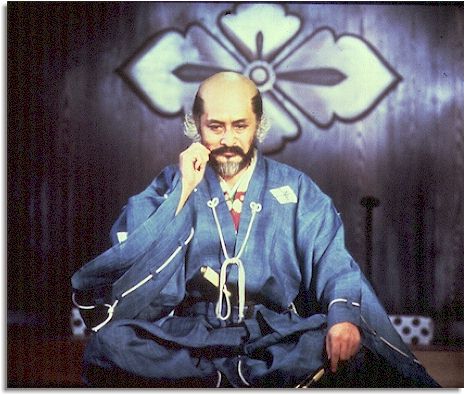
The Shadow Warrior - Kagemusha
1980, Spherical Panavision, color, 179
min [US version 162 min]
Director: Akira Kurosawa
Cast:Tatsuya Nakadai (Shingen Takeda and his double, the Kagemusha), Tsutomu
Yamazaki (Nobukado Takeda, Shingen's brother), Kenichi Hagiwara (Katsuyori Suwa [Takeda],
Shingen's son), Kota Yui (Takemaru Takeda, Shingen's grandson), Shuji Otaki (Masakage
Yamagata, Takeda Clan general, Fire Battalion leader), Hideo Murata (Nobuharu Baba),
Takayuki Shiho (Masatoyo Naito), Shuhei Sugimori (Masanobu Kosaka), Noboru Shimizu
(Masatane Hara), Koji Shinizu (Katsusuke Atobe), Sen [Ren?] Yamamoto (Nobushige Oyamada),
Daisuke Ryu (Nobunaga Oda, Shingen's enemy), Masayuki Yui (Ieyasu Tokugawa, Shingen's
enemy), Yasuhito Yamanaka (Ranmaru Mori), Takashi Shimura (Gyobu Taguchi), Jinpachi Nezu
(Sohachiro Tsuchiya, Shingen's bodyguard), Mitsuko Baisho (Oyunokata, Shingen's
concubine), Kaori Momoi (Otsuyanokata, Shingen's concubine), Akihiko Sugizaki (Noda Castle
solider), Toshiaki Tanabe (Kugutsushi), Yoshimitsu Tamaguchi (salt vendor), Takashi Ebata
(monk), Kumeko Otowa (Takemaru's nurse), Kamatari Fujiwara (doctor), Senkichi Omura
(Takeda's stable boy), Tetsuo Yamashita, Kai Ato, Yutaka Shimaka, Eiichi Kanakubo, Yugo
Miyazaki, Norio Matsu, Yasushi Doshita, Eihachi Ito, Noboru Sone, Masatsugu Kuriyama,
Takashi Watanabe.
Comments:
During Japan's 16th-century warring states period, a condemned thief is saved from
execution by agreeing to serve as a double for Takeda Shingen. Shingen is a powerful
military leader, but when he dies the thief (in his role as "shadow warrior") is
now doomed to play him forever. He even begins to think of himself as Shingen. Only
Shingen's horse can tell the difference, and that is the shadow warrior's undoing.
Notes:
Produced by Francis Ford Coppola and
George Lucas; Assistant Producer, Audie Bock (they got Fox and Toho to put money up
jointly). At $6 million dollars it was the most expensive Japanese film to date and the
first distributed by and invested in by a foreign company. It became an international hit.
While three of Japan's four big studios lost money in 1980, because of Kagemusha
Toho's profits increased by more than 50 percent
Kurosawa made the film partly as a dress
rehearsal for Ran.
Shimura's role cut from the US release
(162 min).
Ten years since Kurosawa had made a film
in Japan.
The lead actor was originally Shintaro
Katsu (famous for his role in the Zato Ichi series) but he was fired about 10 days in to
the shoot. Katsu purportedly had begun to doubt Kurosawa's ability as a director (thinking
him too old), and hired his own independent cameraman to video tape scenes which he would
view as private rushes before continuing. The set was marked by constant bickering.
Kurosawa fired Katsu, reportedly, after punches were thrown.
Kinema Junpo award in 1980 for Best
Supporting Actor (Tsutomu Yamazaki), nominated for an Academy Award for best
Foreign-Language Film (lost to Moscow Does Not Believe in Tears), co-winner of the
Grand Prize at Cannes.
Japanese
Rifles of World War II
by Duncan O. Mc Collum Paperback (January
1996)
Excalibur Publications

Japanese
Hand Guns
by Leith Hardcover (July 1976)
Borden Pub Co
 Military
Pistols of Japan
Military
Pistols of Japan
by Fred L., Jr. Honeycutt Hardcover 3rd edition (November 1991)
Julin Books

Military
Rifles of Japan
by Fred L., Jr. Honeycutt F. Patt Anthony Hardcover
5th
Japanese Army
Handbook 1939-1945
by George Forty
Hardcover -
288 pages 1 edition (July 1, 1999) Sutton Pub Ltd
Japanese Rifles of
World War II
by Duncan O. McCollum
Paperback (January 1996)
Excalibur Publications |